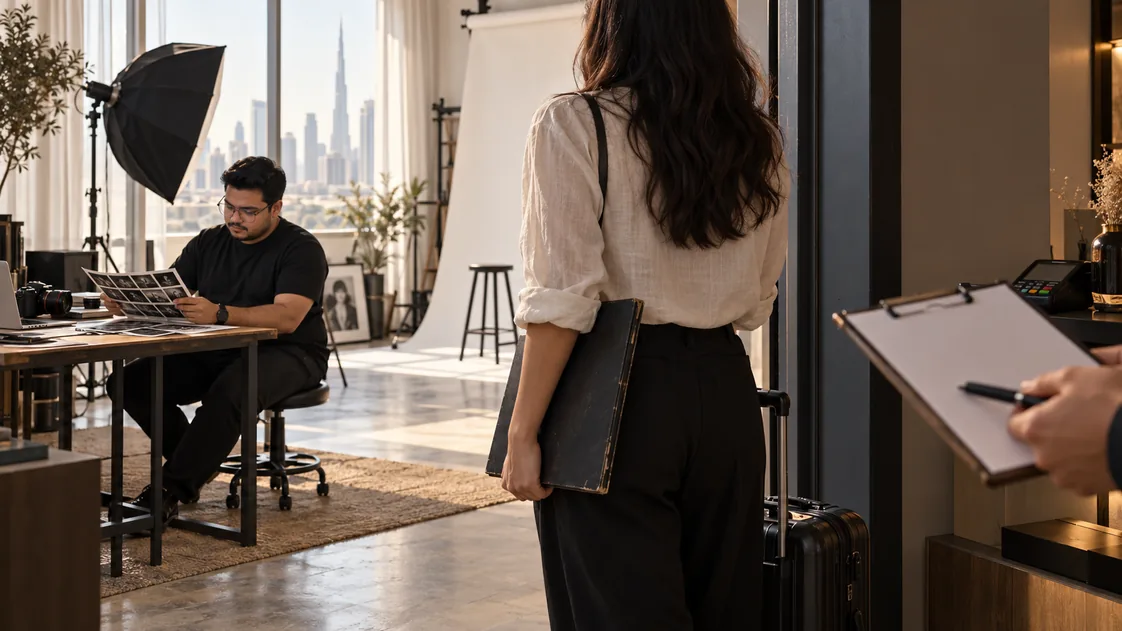
Every season, models land in Dubai with a suitcase, a folder of photos and a lot of hope. Some have a great few months. Others lose money, time and confidence to problems that were easy to spot beforehand.
I am Hatim, a Dubai portrait and model portfolio photographer. I work with models at every stage, and I hear the same questions each year. Do I need a permit? Is this agency real? Should I pay for this? Is it safe to meet this person? This guide answers them as plainly as I can, for models who already live in the UAE and for models travelling here for the season.
One honest limit first: I am a photographer, not an immigration lawyer. Where rules matter, I link the sources I used and tell you to confirm with the authority involved. Rules and fees change, so check the live pages before you act.
The guide at a glance
- Before you book the flight What to have ready, and what to budget.
- Work permission and visas The part most models are never told clearly.
- How work really comes in Agencies, castings, test shoots and rosters.
- Red flags worth walking away from Eight patterns that should make you stop.
- Vet an agency or photographer in ten minutes A short checklist.
- Contracts, money and safety What a fair booking looks like.
- Your first week A calm order of steps for new arrivals.
- If you already live here What changes for residents.
Nobody can promise you bookings, and anyone who does is selling something. What you can control is your preparation, your paperwork and who you trust.
Before you book the flight
The Dubai market is largely commercial: brands, hospitality, real estate, retail, fitness and events. It rewards clean, versatile looks and professional behaviour. The busy period restarts around September, when the heat eases, agencies ask for fresh material and castings resume. My note on the Dubai modeling season explains the rhythm. Summer is quiet, so landing in July and expecting a flood of work is a mistake I see often.
Before you buy a ticket, have these ready:
- Current digitals. A clear headshot, a half-body and a full-length photo, natural and unretouched. Model digitals vs model portfolio explains the format, and why model photos get ignored covers the common mistakes.
- A simple comp card or portfolio link. Use accurate measurements. My guide to the model comp card shows what to include.
- A clear view of your status. Your visa type, how long you can stay and whether you are allowed to work. The next section covers this.
- Money for the first weeks. Accommodation, transport, food and the cost of any new photos. Do not count on income at the start. Bookings take time, and payment often arrives after the shoot, not on the day.
- Contacts you checked yourself. Two or three agencies or photographers you researched, not only names that were sent to you in a message.
Work permission: the part nobody wants to discuss
This is where visiting models take the biggest risk, so I will be direct. A visit or tourist visa is for visiting. It is not permission to work. Dubai Public Prosecution has warned that a foreigner who entered on a visit visa must obtain permission from the competent authority before working in the country, and it listed penalties that include imprisonment, a fine and deportation (Gulf News report of the advisory). Reputable clients and agencies know this too, which is why serious ones ask about your status before they book you.
What counts as work is not something I can define for you. The advisory refers to work in general and does not say whether unpaid work, such as a test shoot, is treated differently. If your plan includes any shoot while you are on a visit visa, paid or not, ask the relevant authority or a qualified lawyer first, and keep the answer in writing.
The legal route depends on your situation. In general, a model who lives in the UAE works under an employer-sponsored work permit or, where the profession is eligible, a freelance permit. Freelance permits are typically issued through certain free zones with a media focus, and your activity has to fit what the issuing body allows (overview by Rödl). Whether a particular agency can arrange a permit for you is a question for that agency, in writing, before you travel. A legitimate one will answer clearly.
If you also post paid or promotional content on social media, the UAE Media Council introduced an Advertiser Permit for individuals who publish promotional content. Check the council’s own site for the current requirements and exemptions.
Do not accept “just come as a tourist and we will sort it out.” Anyone who says this is asking you to carry the legal risk. A real offer comes with clear paperwork.
Photoczaro Models is for people who live in the UAE and are 18 or over. If you are travelling for the season, treat the roster as a goal for when your status allows you to work here.
How work really comes in
There is no single door. In Dubai, work usually arrives in one of four ways.
- Agencies. An agency represents you and brings you bookings, normally for a commission taken from what you earn. My list of the best modeling agencies in Dubai explains how to approach them. Each one decides on its own whom to accept.
- Direct clients and castings. Brands, photographers and production companies hire directly, often after seeing a portfolio or a comp card.
- Test shoots. A test shoot (TFP) trades time for images, with no fee on either side. It is useful for building a portfolio, but it is not a job and nobody should present it as one. See the permission point above.
- Rosters and platforms. A roster such as Photoczaro Models lets clients browse and request models. Read how any platform makes its money before you join.
A word on exposure. Exposure does not pay rent. It is fine to accept unpaid work occasionally, when you choose to and for a clear reason, such as portfolio images from a photographer whose work you trust. It is not fine to be pressured into it, or to be told it is a condition of getting paid work.
I do not publish rate figures here. Rates vary widely with the client, the usage and the market, and a number from me could hurt you in a negotiation. What I can say is this: always ask for the rate, the usage and the payment date before you say yes.
Red flags worth walking away from
Most problems in modeling look like opportunities at first. One flag on its own is not always proof of a scam, but several together are a reason to stop and ask questions.
- Fees to join or to be “registered”. An agency earns from your bookings. Being asked for a signing, registration or portfolio fee up front is the most common warning sign. UAE labour rules also say employers cannot charge workers for recruitment costs, directly or indirectly (Gulf News explanation).
- Photography as a condition. A paid shoot is not automatically a scam, and photographers deserve to be paid. It becomes a red flag when paying is required before an agency will consider you, or when you must use their photographer. At Photoczaro, applying is free and paid photography is never a condition of being considered.
- Your original passport. Do not hand over your original passport as a deposit or for safekeeping. A copy is normally enough for early paperwork. UAE labour law says an employer must not withhold a worker’s official documents, with a limited exception for visa processing and only with your consent (Gulf News guide). If it is kept, you can complain to MOHRE or contact your embassy.
- Vague or missing contracts. No written terms, unclear exclusivity, no mention of commission, usage or payment dates, or a contract in a language you cannot read.
- Pressure. “Sign today.” “Only two spots left.” “We leave the country tomorrow.” A real opportunity survives a night of sleep.
- Guarantees. Guaranteed bookings, fame, income or a visa. Nobody can guarantee these.
- A business you cannot verify. No licence number, no real address, a logo copied from another company, a profile with many followers and few real posts, or a message from a lookalike account or email domain.
- Odd meeting conditions. A first meeting at a private apartment or hotel room, a request to come alone, nude or “private” test images, or a shoot with no named client.
If you receive a job offer that looks real but asks for money, Gulf News has a useful list of job-scam signs.
Vet an agency or photographer in ten minutes
- Look at their own website and social accounts. Do they show real, consistent work, real people and credits you can check?
- Use the contact details on the official website. Write to them there, not to a number or account that contacted you first.
- Ask for the trade licence number and the name on it. A legitimate UAE business holds a licence, and you can verify it with the licensing authority.
- Ask about recent clients. Then check one credit yourself.
- Search the name with “review” and “complaint”. One angry review proves little. A pattern says a lot.
- Ask for the terms in writing. Fees, commission, exclusivity, how payment works and what happens if a booking is cancelled.
- Notice how they answer questions. A professional is patient. A scammer gets irritated or goes quiet.
Contracts, money and safety
Before any shoot you should have a booking confirmation in writing, even if it is a message. A fair one includes:
- Who, when and where. Date, call time, location and the name of the client or production.
- What the job is. What you will wear and what is shot. Anything involving nudity or lingerie is agreed in advance, and you can say no.
- Fee and payment date. The amount, how it is paid and when.
- Usage. Where the images may appear and for how long. A social post is not the same as a billboard.
- Cancellation and overtime. What happens if the shoot is moved, cancelled or runs long.
- Costs. Who covers transport, hair and makeup, and meals.
Keep every message and document. If you do not understand a clause, do not sign yet. Ask for it in a language you read, or have someone you trust explain it. Payment after the shoot is common, so a late payment is not automatically a scam. A payment date that keeps moving, however, is a reason to pause further jobs with that client and to speak to your agency.
For safety, tell a friend where you are, who you are with and when you expect to finish. Choose a public place or a professional studio for a first meeting, not a private home. Bring a friend if you want to, because a professional will not mind. You can leave at any point if something feels wrong. Dubai is widely seen as a safe city, but that is no reason to skip basic checks. This applies to photographers too, including me: ask how a session works before you book it.
Your first week in the UAE
- Confirm your status and paperwork. Get the answers about permission in writing, and keep digital and paper copies of your documents. Originals stay with you.
- Refresh your materials. Retake digitals if anything about your look has changed, and update your comp card.
- Apply to the agencies you checked. Follow each application page exactly. If you live here and are 18 or over, apply to the roster.
- Attend castings and meetings in person. Choose public or professional venues, arrive on time, and wear simple fitted clothing with minimal makeup.
- Review your budget and follow up once. A polite single follow-up is enough. Drop anything that made you uneasy.
If you already live in the UAE
Most of the above still applies to you. Add a few habits: keep your visa and any permit valid, and check which activities your permit covers. Refresh your digitals each season, as described in the season guide. Keep a simple record of jobs, fees and payment dates. And be as careful with offers as a newcomer would be, because scammers target residents too.
Frequently Asked Questions
This guide is general information, not legal or immigration advice. Rules, permits and fees change, so confirm them with the relevant authority. Sources referenced: Gulf News on Dubai Public Prosecution's visit-visa advisory, Rödl on freelancers in Dubai, WAM on the UAE Media Council Advertiser Permit, Gulf News on recruitment costs, Gulf News on employers holding passports and Gulf News on job-scam signs. Photoczaro is not affiliated with any agency or authority named above.
Hatim Champeli is a Dubai-based portrait and model portfolio photographer, available across the UAE. His work has appeared in international magazines. Read more about Photoczaro.
Your next step: apply to the roster
Everything above comes down to one habit: work with people who are clear, written and unhurried. Photoczaro Models is built on that idea. It is a UAE roster that clients can book models from, applying is free and non-exclusive, and nobody has to buy photography to be considered. If you live in the UAE and are 18 or over, the application takes a few minutes.
Apply to Photoczaro Models
Free to apply, non-exclusive and open to anyone aged 18 or over who lives in the UAE. You only need simple, current photographs. Applying does not guarantee acceptance or bookings, and paid photography is never a condition.
Want to see how the roster works first? Read how to book models from the Photoczaro roster.