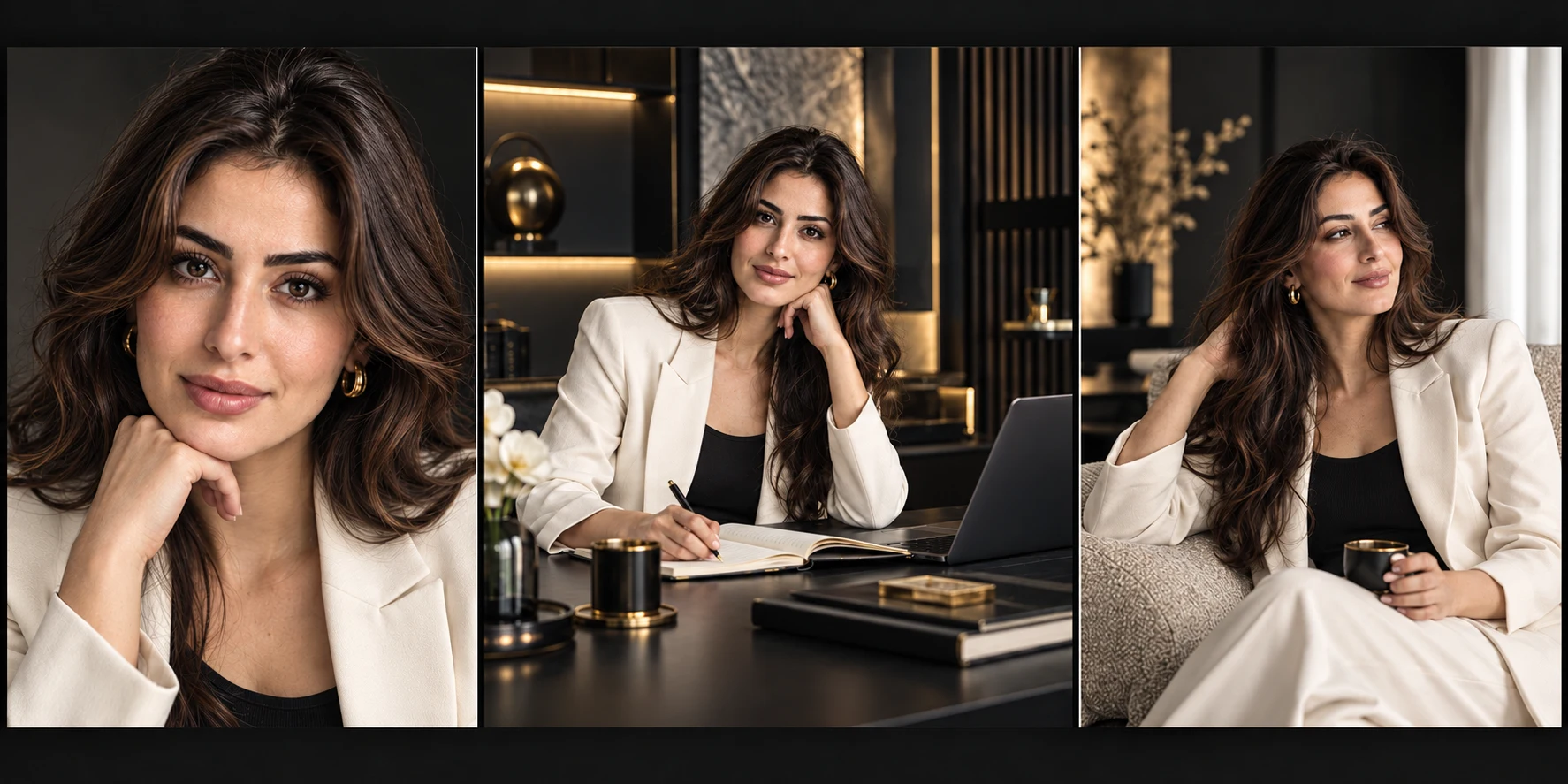
A personal branding photoshoot should do more than produce one professional headshot.
It should create a clear visual introduction to who you are, what you do and how you want people to perceive your work. The photographs may appear on your website, LinkedIn profile, social media, company biography, speaking profile, press feature or marketing material, but they should still feel like the same person and the same brand.
That does not mean every photograph must look identical. A strong personal branding collection can move between polished, professional and relaxed moments while maintaining a consistent visual identity.
The most useful starting point is a simple three-part sequence:
- A clean headshot that introduces you clearly
- An environmental working portrait that shows what you do
- A relaxed lifestyle frame that reveals more of your personality
Together, these images provide more context than a conventional corporate portrait alone.
This guide explains how to plan a personal branding photoshoot in Dubai, from defining your purpose and selecting a location to preparing your wardrobe, expressions and final shot list.
A personal branding photoshoot in Dubai gives you a small, consistent set of images for your website, LinkedIn and press: a clean headshot, a working portrait and a relaxed lifestyle frame. Start with your purpose, pick one or two locations that fit your work, and plan a short shot list. If you only need a single profile photo, a professional headshot may be enough.
1. What is personal branding photography?
Personal branding photography is a planned collection of portraits created to represent an individual professionally.
Unlike a standard headshot, which usually focuses closely on the face and shoulders, personal branding photographs can include:
- Clean professional portraits
- Environmental photographs in a workspace
- Images of you performing relevant activities
- Relaxed lifestyle portraits
- Detail photographs of tools, products or surroundings
- Vertical and horizontal compositions for different platforms
The aim is not to make your daily life appear more dramatic than it is. The aim is to communicate your professional identity clearly and attractively.
A consultant may need photographs that convey experience and approachability. A founder may want to show both leadership and the human personality behind the business. A creative professional may need more expressive imagery that still feels commercially usable.
The visual direction should follow your actual work rather than forcing everyone into the same polished blazer-and-laptop formula.
2. Who benefits from a personal branding photoshoot?
Personal branding photography can be useful for:
- Founders and business owners
- Consultants and advisers
- Executives and sales professionals
- Designers and creative professionals
- Real-estate professionals
- Coaches and trainers
- Content creators
- Speakers and educators
- Freelancers and independent specialists
- Professionals preparing for press features or public appearances
It can also help someone changing industries, launching a new business or rebuilding an outdated online presence.
The important question is not whether you consider yourself a "personal brand." If people search your name before contacting, hiring or meeting you, your existing photographs already contribute to how they perceive you.
The photoshoot gives you an opportunity to shape that impression intentionally.
3. Begin with the purpose, not the location
Dubai offers striking architecture, offices, studios, cafés, hotels, beaches and desert settings. However, choosing a beautiful location before understanding the purpose of the photographs can create attractive images that are difficult to use.
Start by asking:
- Where will the photographs appear?
- Who needs to trust or understand me?
- What should they feel when they see the images?
- Should the impression be formal, creative, approachable, authoritative or relaxed?
- Do I need photographs for one immediate use or a wider content library?
- Will the images support a personal profile, company brand or both?
A legal or financial professional may benefit from clean architecture and restrained styling. A designer may need richer textures, colour and visible creative tools. A founder might need a mixture of formal portraits, working moments and relaxed frames for interviews or social content.
The setting should support the message rather than compete with it.
4. Build the photoshoot around three essential images
The clean headshot
The headshot is the most direct photograph in the set. If a headshot is the main priority rather than the full three-image sequence, see the dedicated guide to professional headshots in Dubai for what that session looks like on its own.
It should show your face clearly, use controlled lighting and remain suitable for platforms where the image appears very small, such as LinkedIn, email profiles, speaker listings or company-team pages.
A strong personal-brand headshot does not always require a plain white background. Dark neutrals, warm architectural tones or a softly blurred environment can also work when they match your visual identity.
The expression matters just as much as the background. Depending on your profession, the portrait may need to feel:
- Calm and assured
- Warm and approachable
- Direct and authoritative
- Creative and thoughtful
- Polished without becoming distant
The expression should still look believable. A forced corporate smile can weaken an otherwise technically perfect photograph.
The environmental working portrait
An environmental portrait places you in a setting connected to your work.
This might include:
- Working at a desk
- Reviewing a notebook or document
- Speaking during a meeting
- Using a relevant tool or product
- Moving through an office or studio
- Presenting or explaining something
- Interacting with your working environment
The action should feel purposeful, not staged for its own sake.
A laptop can be relevant for many professionals, but it should not become an automatic prop in every personal branding photograph. The environment should reveal something specific about your work, process or personality.
The strongest working portraits usually capture the moment between a formal pose and a completely candid photograph. You remain aware of the camera, but you have a natural action to perform.
The relaxed lifestyle portrait
The lifestyle frame adds personality to the collection.
It may show you seated near a window, walking through an architectural space, enjoying a coffee, adjusting a jacket or looking away from the camera during a quieter moment.
This photograph is particularly useful for:
- Social-media introductions
- Website About pages
- Interview features
- Thought-leadership articles
- Personal announcements
- Less formal marketing content
Relaxed does not mean visually disconnected from the rest of the shoot. The lighting, wardrobe and colour treatment should still belong to the same story.
5. Choosing a personal branding location in Dubai
The best location depends on the message, required privacy, intended usage and practical permission.
Your office or workspace
A genuine workplace can provide the most relevant context. It may also include recognisable details that strengthen the authenticity of the images.
Before confirming it, check:
- Whether photography is permitted
- Whether confidential information can be hidden
- Whether the available light is suitable
- Whether the background can be organised
- Whether colleagues or customers will interrupt the session
- Whether the space provides enough visual variety
A real office does not need to look like a furniture showroom. Careful framing and lighting can make a simple space feel intentional.
A photography studio
A studio offers greater control over lighting, background and privacy.
It works well when you need clean headshots, carefully directed portraits or a visual style that is difficult to create in a busy public environment.
A studio can also be styled to feel warmer and more personal through chairs, tables, textured backgrounds or selected props.
A rented interior
Hotels, meeting spaces, creative studios and carefully selected interiors can provide a polished environment without pretending to be your permanent office.
Permission and commercial usage should always be confirmed with the venue before the shoot.
An outdoor location
Dubai's architecture can work beautifully for founders, consultants, property professionals and creatives who want a more open or contemporary identity.
Outdoor planning must account for:
- Heat and humidity
- Wind
- Crowds
- Changing light
- Privacy
- Photography permissions
- Walking distance between frames
- Space for wardrobe adjustments
Early morning and late afternoon generally provide more comfortable conditions and softer light, but the exact timing should be selected for the chosen location and visual direction.
6. Plan a consistent visual identity
Personal branding photography works best when the photographs share a recognisable visual language.
That consistency can come from:
- A controlled colour palette
- Similar lighting across the sequence
- Repeated materials or textures
- Coordinated wardrobe choices
- A consistent editing style
- Intentional use of formal and relaxed expressions
For Photoczaro, that direction may be cinematic, refined and editorial while still feeling natural. Dark neutrals, warm ivory, muted gold, architectural texture and controlled directional light can create a sophisticated result without making the images feel theatrical.
Your existing brand should influence the decisions. If your website uses soft neutral colours, suddenly introducing highly saturated clothing and bright backgrounds may create images that are difficult to integrate.
Bring your website, logo, colour palette or existing marketing material into the planning conversation.
7. What to wear for a personal branding photoshoot
Wardrobe should support your professional identity without becoming the subject of every photograph. For general guidance that applies beyond personal branding, see what to wear for your photoshoot.
A useful selection can include:
- One polished professional look
- One slightly relaxed variation
- One outfit that reflects your specific industry or personality
For example, the same tailored jacket can move between a clean headshot, a working portrait and a more relaxed seated image. Removing the jacket or changing one layer can create variety without making the final gallery feel like three unrelated photoshoots.
Consider:
- How the colour works with the location
- Whether the clothing fits comfortably when sitting and standing
- Whether patterns create visual distraction
- Whether prominent logos are appropriate
- Whether jewellery reflects unwanted light
- Whether the outfit still represents how you meet clients professionally
Bring clothing properly prepared. Creases, visible lint and poor fit are harder to ignore in a high-resolution portrait.
The goal is not to wear something unfamiliar because it appears "professional." It is to present a refined version of how you genuinely want to be seen.
8. Grooming, hair and makeup
Personal branding photographs should remain recognisably you.
Hair and makeup can be polished without changing your identity. If professional makeup is used, communicate that the photographs require natural skin texture and consistency with how you normally appear.
Before the session:
- Avoid experimenting with unfamiliar treatments
- Prepare hair and facial grooming in advance
- Keep skin hydrated
- Bring basic touch-up items
- Check glasses for marks or reflections
- Bring a lint roller
- Confirm whether any appearance changes are planned
Retouching can refine temporary distractions, but it should not replace preparation or reshape the person in the photograph.
9. Use props carefully
Props can add context when they genuinely relate to your work.
Useful examples include:
- A notebook
- A laptop or tablet
- Printed plans or documents
- A camera or creative tool
- Product samples
- Materials used in your profession
- A book relevant to the environment
Avoid filling the frame with generic business objects simply because they signal "work." Too many props can make the image look staged and date it quickly.
Every item should have a reason to appear.
10. Create a practical shot list
A shot list helps ensure that the photoshoot produces useful variety rather than many similar images.
Your personal branding shot list might include:
- Direct headshot with a neutral expression
- Approachable headshot with a natural smile
- Three-quarter standing portrait
- Seated professional portrait
- Horizontal website-banner composition
- Vertical social-media composition
- Working at a desk
- Looking through a document or notebook
- Speaking or presenting
- Walking portrait
- Relaxed seated lifestyle frame
- Detail photograph of hands or working tools
- Wider environmental portrait
- Negative-space composition for text placement
The list should remain flexible. Some of the strongest photographs may appear during transitions, conversation or adjustments between planned frames.
A shot list is a guide, not a reason to ignore a better moment.
11. You do not need to know how to pose
Most professionals are not models, and a personal branding photoshoot should not expect them to arrive with a collection of memorised poses. See posing guidance for first-time clients for more on what direction actually sounds like during a session.
Direction may include:
- Adjusting posture
- Positioning the hands
- Changing the angle of the shoulders
- Refining the gaze
- Creating movement
- Working with clothing
- Slowing down an action
- Shifting between professional and relaxed expressions
Small instructions usually produce more natural results than asking someone to perform a completely different pose every few seconds.
The three-image sequence should feel connected while showing range. You are not becoming three different characters. You are presenting three credible sides of the same professional identity.
12. Plan for different platforms
A photograph that works perfectly as a full-width website banner may not work as a circular profile image.
Before the session, identify the required formats:
- LinkedIn profile
- Website homepage
- About page
- Company-team profile
- Press biography
- Speaker profile
- Instagram portrait
- Vertical Story or Reel cover
- Horizontal article banner
- Email signature
- Presentation
- Marketing collateral
The photographer can then leave suitable negative space and create vertical, horizontal and close-cropped options.
It is more efficient to plan these compositions during the photoshoot than to force one photograph into every platform afterward.
13. Understand personal and commercial usage
How the photographs will be used should be discussed before the session.
A portrait used on your personal LinkedIn account is different from an image used by a company in paid advertising, print campaigns or large-scale commercial promotion.
Explain:
- Who will use the images
- Where they will appear
- Whether paid advertising is planned
- Whether third-party publications may receive them
- Whether the company or individual is commissioning the shoot
- Whether future commercial use is likely
Clear usage expectations protect everyone and ensure the quotation reflects the real purpose of the photographs.
Choosing a personal branding photographer in Dubai
The photographer shapes the result as much as the location does. Before you book, check:
- Relevant work. Do they show portraits of people in jobs like yours, with a consistent look?
- Direction. Will they plan the purpose and shot list with you, and guide your poses on the day?
- What is included. The number of edited images, the turnaround and the file formats.
- Usage. Where you may use the images, such as web, social media, press or advertising, in writing.
- Practicalities. Location permits where needed, wardrobe advice and a plan for heat if you shoot outdoors.
For typical costs and what affects them, read the photoshoot cost guide for Dubai. If you want to talk through a personal branding session with me, start on the work with me page.
Personal branding photoshoot checklist
Before confirming your session, prepare:
- The purpose of the photographs
- Your target audience
- The platforms and formats required
- Your brand colours or website
- A small, focused set of visual references
- Preferred wardrobe options
- Location ideas
- Relevant props
- Any photography or venue permission
- Grooming and makeup requirements
- Comfort boundaries
- Intended image usage
- Your preferred dates or date range
You do not need to solve every creative decision alone. These details give the photographer enough context to recommend the right direction.
Frequently Asked Questions
Plan your personal branding photoshoot in Dubai
A successful personal branding photoshoot should feel intentional without feeling artificial.
The clean headshot introduces you. The environmental portrait explains what you do. The relaxed lifestyle frame allows people to see more of the person behind the work.
When those photographs share the same visual identity, they can support your website, professional profiles, press features and marketing content without making your brand appear inconsistent from one platform to another.
Photoczaro creates directed personal branding and professional portrait sessions in Dubai, planned around your work, audience and intended image usage.
Share what you do, where the photographs will be used and the impression you want them to create. Work with me and from there, we can plan the visual direction, setting and shot list around your actual goals.
Work with me
Based in Dubai. Tell me what you do, where the photographs will be used and the impression you want them to create, and I'll help plan the visual direction, setting and shot list around your actual goals.