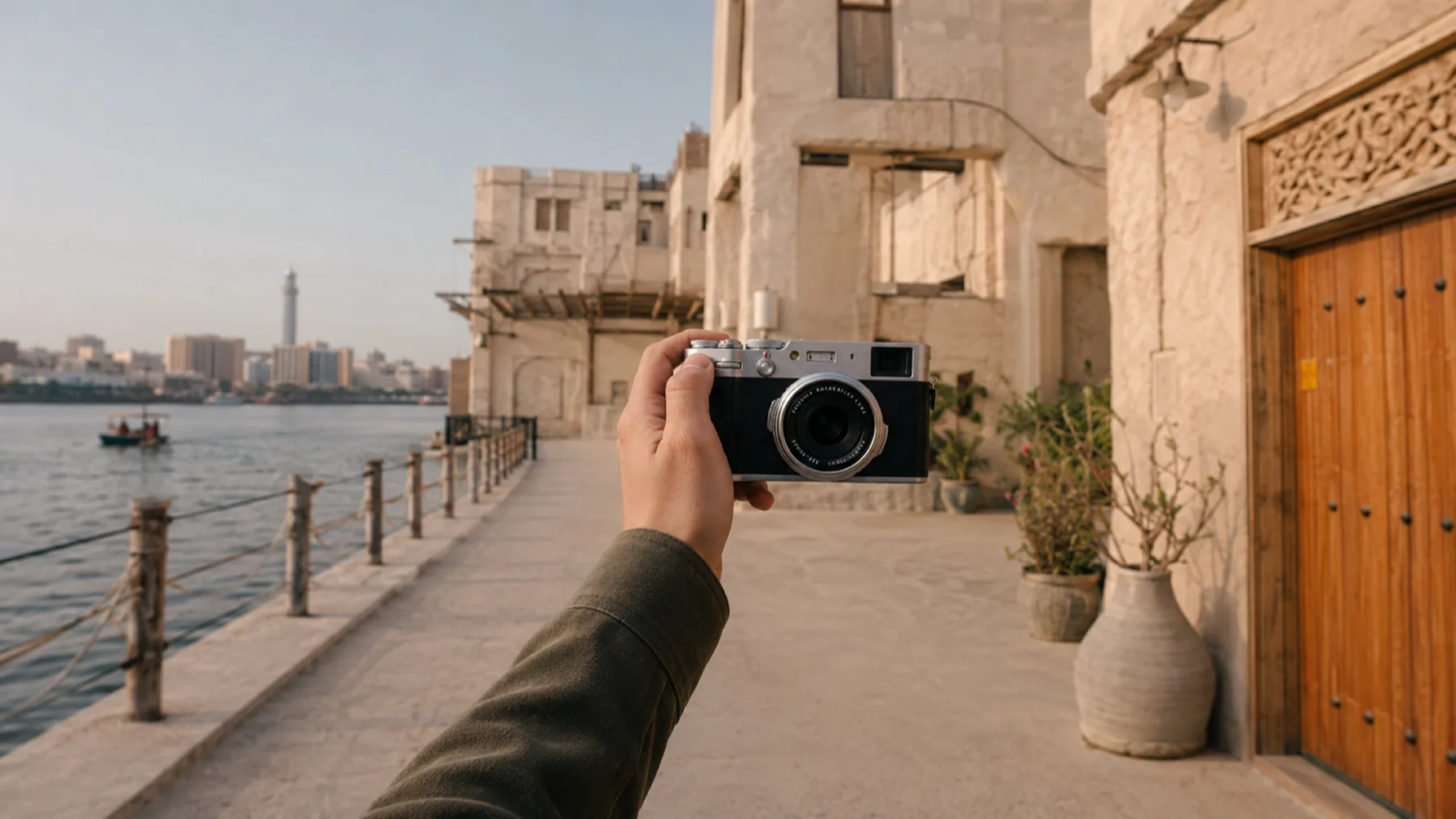
I waited eight months to get my hands on this camera. Was it worth it? Mostly yes - but not for the reasons I expected.
Let me be upfront about something: I was skeptical. The X100V had become almost mythological at this point, the camera everyone wanted and nobody could find. When Fujifilm announced the VI, the internet went exactly the way the internet goes - people who had never touched a fixed-lens camera suddenly needed one, and the preorder queues became a second career for resellers. I wasn't sure I wanted to be part of that.
But I shoot a lot in Dubai, and Dubai has a specific problem that this camera addresses better than almost anything else I've used: you can't always look like you're shooting. On public streets, near certain buildings, in souks - a big mirrorless body with a 70-200 attached to it draws attention. Sometimes that's fine. Often it isn't. The X100VI looks like a tourist camera, which is exactly why it's genuinely useful.
What actually changed
The 40MP sensor is the headline upgrade and it delivers. I was shooting the VI at ISO 6400 in a poorly lit warehouse space for a project last October, and the files were genuinely usable - clean in a way that surprised me. Push into 12,800 and you get grain, but it's film-like grain, not digital mush. The noise reduction in-camera is still too aggressive on Auto if you let it run, so I keep NR at -2 and deal with it in Lightroom.
IBIS is the other major change. The V had no stabilisation at all, which made the 35mm-equivalent focal length trickier in low light than you'd expect. The VI's IBIS is rated at 6 stops and I think that's roughly accurate in practice - not the same as the system you get in a full XT-5 with a stabilised lens, but enough that I'm not throwing away frames the way I used to.
The X100VI looks like a tourist camera. In Dubai, that's not a limitation - it's the point.
What hasn't changed: the autofocus. It's better than the V - the subject detection is actually reliable now in good light - but if you're coming from a Sony A7R V or even a recent Nikon Z-series, you will feel the difference immediately. For street and environmental portraits, it keeps up. For fast editorial work with unpredictable subjects, I still reach for something else.
The fixed focal length question
This is the thing people argue about most and I'll give you my honest answer: 35mm equivalent is not my natural eye. I see in 50mm. The first few weeks with the X100VI felt constraining - I kept wanting to zoom, to compress backgrounds, to do things this camera simply won't do.
Then something shifted. When you can't zoom, you move. You get closer or further, you change your angle, you make decisions with your feet that you'd normally make with your hands. My compositions became less lazy. That's not a diplomatic way of saying I enjoy limitations - I'm saying the constraint forced me to be more deliberate, and some of my favourite frames from the last six months came from this camera in situations where I would have defaulted to the easy option on a zoom.
The teleconverter (TCL-X100 II) adds an effective 50mm option and the WCL-X100 II goes wider to 28mm equivalent. I have both. I almost never use them - they add bulk and defeat part of the point. If I need those focal lengths regularly, I pick up a different body.
Dubai-specific notes
Heat affects this camera. Nothing dramatic, but if you've been shooting in direct sun for three hours in August and the body has been sitting in a bag, give it five minutes before you start shooting in a cold interior. I've had two instances where autofocus became unreliable after an extended heat soak, and both resolved after the camera cooled down. Worth knowing.
The ND filter built into the lens is something I use constantly here. Dubai golden hour is still often blinding - harsh directional light even when the sun is low. Having four stops of ND built in without having to screw anything onto the lens is genuinely convenient. It's not a replacement for a proper ND stack when you're doing long-exposure work, but for portraits outside in strong afternoon light, it buys you room to open up the aperture.
Six months in, the X100VI lives in my bag on almost every shoot as a second body. There are things I miss - the ability to change lenses obviously, a more robust AF system for fast subjects, longer battery life. But as a camera that lets me move quickly, shoot quietly, and produce files I'm genuinely happy with, it's earned its place.
If you're on the fence: if a fixed 35mm-equivalent lens sounds like a limitation you'd constantly fight, this camera will frustrate you. If you're willing to work with it rather than against it, it's one of the more enjoyable things I've shot with in a long time.
Work with me
Based in Dubai. If you're a model or agency looking for a photographer who knows their gear inside out, WhatsApp is the fastest way to reach me.